|
|
Les forêts tropicales:
Diversité de la forêt tropicale
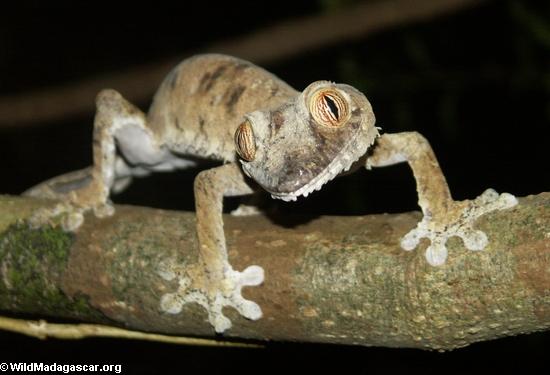 Gecko à queue de feuille dans la forêt tropicale de Madagascar. (Photo by R.
Butler)
Gecko à queue de feuille dans la forêt tropicale de Madagascar. (Photo by R.
Butler)
|
|
DIVERSITE DE LA FORET TROPICALE - ORIGINES ET IMPLICATIONS
Les forêts tropicales abritent la plus grande diversité d'organismes sur
Terre.
Bien qu'elles couvrent moins de 2% de la surface de la Terre, elles
abritent environ 50% de la vie sur la planète. Le nombre de créatures qui
habitent
les forêts tropicales est si grand—un estimation de 5-50 millions d'espèces—
qu'il est presque incompréhensible.
La fouchette de ces chiffres suggère à elle seule à quel point l'étendue de
nos
connaissances de ces forêts est limitée. Par exemple, tandis que les forêts
modérées
sont souvent dominées par une demie douzaine d'espèces d'arbres ou moins
formant 90%
des arbres dans la forêt, une forêt tropicale peut avoir plus de 480 espèces
d'arbres
dans un seul hectare (2,5 acres). Un seul buisson en Amazonie peut avoir
plus d'espèces
de fourmis que toutes les îles britanniques réunies. Cette diversité des
forêts tropicales
n'est pas le fait du hazard, mais est le résultat d'une série de
circonstances uniques.
Portraits de
Diversité
Pays ayant la plus
Grande Biodiversité
Qu'est-ce que la biodiversité?
Biodiversité -- abbréviation pour Diversité Biologique -- est le nombre et
les différents types d'organismes présents dans un écosystème, une région ou
un environement,
Suite: Rôle du Climat, de l'Energie Solaire et de la
Stabilité
Dernières informations sur les peuples des forêts tropicales
[Toutes les
Nouvelles de la Biodiversité]
[an error occurred while processing this directive]
À moins qu'où expressément indiqué, tout contenu sur ce site Web ait été écrit par Rhett A. Butler. Ce site Web a été traduit par Doriane A.
Otras paginas:
|
|
|
|
MONGABAY.COM
Mongabay offre des actualités et des informations sur la faune et l'environnement.
Mongabay.com cherche à éveiller l'intérêt pour la faune des zones sauvages, tout en examinant l'impact sur la conservation et le développement des nouveautés concernant le climat, l'énergie, les technologies, les sciences économiques et les finances.
Sommaire
Acheter des photos
|
|
|
|