|
ABATTAGE DES ARBRES
L'abattage des arbres est l'une des méthode proéminente et la plus connue de dégradation de la forêt tropicale. Malgré des techniques d'abattage améliorées, une plus grand sensibilisation internationale, l'inquiétude pour les forêts tropicales, l'abattage non renouvelable des forêts tropicales continue—effectué en majorité par les organisations criminelles illégales.
A la fin des années 90, après avoir épuisé la majorité de leur stock de bois, les entreprises asiatiques d'abattage d'arbres se déplacèrent aggressivement dans les zones forestières tropicales incluant le Nord Est de l'Amérique du Sud (Guyane, Suriname); l'Amazonie Brésilienne; le Bassin du Congo d'Afrique Centrale; Le Pacifique Sud, en particulier les îles Solomon, la Papouasie Nouvelle Guinée; et l'Amérique Centrale. Les entreprises de bois de construction Chinoises ont été particulièrement actives récemment, après que le gouvernement ait interdit l'abattage des arbres dans le pays suite aux inondations catastrophiques de 1998. Avec le boum du bâtiment attisant la demande en bois, la Chine a récemment été liée à du bûcheronnage en Afrique, l'Amazonie, la Birmaniea, et l'Indonésie.
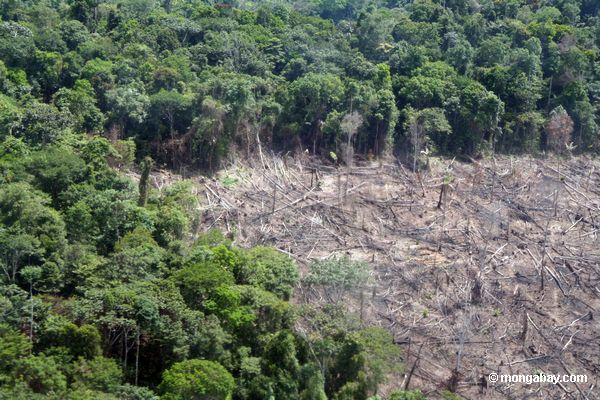
Les opérations d'abattage typiques causent beaucoup de dommages à l'écosystème de la forêt trpoicale. Les problèmes viennent de la nature limitée en temos des conecessions forestières, ce qui encourage l'épuisement de la ressource à court terme, et de la mauvaise plannification et gestion de la forêt. La corruption est très répandue dans de nombreux pays tropicaux producteurs de bois, ce qui rend les lois de foresterie quai impossible à appliquer, tandis que le manque de transparence dans les transactions commerciales signifie que les bureaucrates corrompus peuvent donner des concessions à leurs copains sans respect pour l'environnement ou les peuples locaux. La structure de la forêt tropicale elle-même — où aucune espèce ne domine et les arbres au bois attirant sont largement dispersés— signifie qu'il est simplement plus rentable de faire de coupes claires de la forêt. Même sans coupe-claire, la construction des routes d'abattage pour atteindre les ressources de la forêt est déstructrice en elle-même et encourage la colonisation de terres préalablement inaccessibles. Des études menées par l'Environmental Defense Fund montrent que les zones qui ont été éboisées de manière sélective ont huit fois plus de chances d'être colonisées et éclaircies par des cultivateurs itinérants que les forêts tropicales non touchées à cause de l'accès apporté par les routes d'abattage. La recherche a trouvé une forte corrélation entre la présence des routes d'abattage et la consommation de "bushmeat"—animaux sauvages chassés comme nourriture.
Les routes d'abattage mises à part, l'abattage sélectif lui-même —oû seule une ou deux espèces d'arbres de valeur sont récoltées sur une zone—peut faire beacoup de mal sur les forêts tropicales primaires. Une étude de 2005 exécutée par des scientifiques de la Carnegie Institution de l'Université de Stanford détermina que "l'abattage sélectif" crée 2 fois plus de dommage qu'il n'est détecté par satellite tout en émettant 25% plus de gas a effet de serre qu'on ne le pensait.
L'abattage sélectif -tel qu'il l'est habituellement pratiqué- dégrade la forêt car la chute d'un seul gros arbre peut entraîner la chute de douzaines d'arbres autour qui lui sont lié pas les lianes et plantes grimpantes. L'amincissement de de la canopée protectrice expose la forêt à une plus forte luminosité solaire et aux vents séchants qui peuvent tuer les organismes symbiotiques du sol essentiels pour la décomposition et la fixation des nutriments, tout en séchant le tapis de feuille et augmentant la vulnérabilité de la forêt aux incendies. En plus, l'utilisation de tracteurs pour récupérer les arbres peut déchirer le sol et accroitre l'érosion. Il a été prouvé que l'abattage sélectif réduit la biodiversité globale en détruisant l'habitat des espèces de la forêt tropicale.
These tropical logging operations widely fail to safeguard timber stocks for future harvests and fail to protect logged-over forest from fire, biodiversity loss, over-hunting, and subsequent conversion for agriculture or pasture. But the damage caused by clear-cutters is even worse. Operators who do not practice selective logging may instead simply burn a forest tract after valuable trees have been removed.
Tableau: déboisement des pays tropicaux
Tableau: déboisement industriel des pays tropicaux
Abattage . . . style Amphetamine
Un compte de l'abattage illégal en Thaïlande
Economies faibles
Les pays en voie de développement ne voient souvent qu'un fraction de l'argent qu'ils méritent des opérations légales d'abattage, et encore moins de l'abattage illégal, qui, selon les estimations de la Banque Mondiale, coûte aux gouvernements environ 5 Milliards de dollars en revenus perdus par an et touche les economies nationales de 10 Milliards de dollars en plus par an. Les entreprises d'abattage peuvent souvent trouver ou créer des lacunes dans la législation qui leur permettent de payer très peu pour les concessions tout en évitant parfois de payer des taxes sur les bûches qu'elles prélèvent. Par exemple, un accord d'abattage de 1994 au Suriname accorda 25% des terres du Suriname (7,5 millions d'acres ou 3 millions d'hectares) à moins de 35 USD par acre, tout en négligeant des dispositions pour protéger l'environnement, reboisé les zonnes déboisées, ni même autoriser le pays à monitorer adéquatment les activités d'abattage. A l'époque, les estimations de l'U.S. Forestry Service et Harvard Law School prévisirent que tandis que les abatteurs gagneraient quelques 28 millions de dollars par and, le pays n'en verrait que 2 millions. En même temps, à la fin de années 90, le gouvernement Cambodgien perdait tellement d'argent en ne collectant pas les taxes sur le bois que l'IMF annula un emprunt de 120 millions de dollars et la Banque Mondiale suspendit l'aide directe au gouvernement jusqu'à ce que le problème de la corruption dans le secteur forestier soit résolu. Apparemment ces actions ne furent pas suffisantes pour ralentir la perte de la forêt: entre 2000 et 2005, le Cambodge perdit presque 30% de sa couverture de forêt primaire. Au Nigéria, qui perdit le plus haut taux de forêt primaire (55,7%) durant la première moitié de cette décennie, WEMPCO, un entreprise d'abattage de Hong Kong, paya 28$ au gouvernement pour chaque arbre d'acajou tout en revendant le bois à 800$ par mètre cube, environ 2.900$ l'arbre.
Importation d'arbres feuillus tropicaux au Japon
Importation Totale de bois tropical au Japon Les pays tropicaux perdent également des revenus potentiels en exportant les troncs avant de les traiter, quand le bois a sa valeur la plus basse. Plusieurs pays, incluant le Cambodge, les îles Salomon, et la Birmanie, ont inrterdit l'exportation de bois brute pour essayer d'augmenter les revenus des opérateurs locaux et du gouvernement, mais du bois brute est régulièrement sorti clandestinement par les organisations criminelles.
"Abattage viable"
La foresterie viable est possible, mais d'après l'International Tropical Timber Organization, moins d'1% de l'abattage dans les tropiques est vraiment viable. Dans une récente étude, aucun des 34 sites de l'Etat de Para au Brésil ne répondait aux conditions d'abattage exigées par l'ITTO que le Brésil avaiit accépté d'implémenter avant l'an 2000. Plusieurs techniques telles que l'abattage par bande et l'abattage à impact réduit (Voir Ch 10: Solutions: "abattage viable") ont du potentiel, mais ne servent pas à grand chose si elles ne sont pas adoptés.
Les opérations d'abattage de la forêt tropicale sont aussi particulièrement sujettes aux "greenwash" où une entreprise prétend employer des techniques d'abattage viable mais en réalité n'implémente même pas les protections les plus basiques.
Questions pour résumer:
- Pourquoi l'abattage sélectif peut il être destructif dans la forêt tropicale humide?
- Comment appelle-t-on la chasse d'animaux sauvages pour nourriture?
- Qu'est ce que le greenwash?
[Imprimer]
Suite: Exploitation mini&re dans la Forêt Tropicale
À moins qu'où expressément indiqué, tout contenu sur ce site Web ait été écrit par Rhett A. Butler. Ce site Web a été traduit par Doriane A.
Otras paginas:
|