|
|
Les forêts tropicales:
Richesses en péril—Forêts Tropicales menacées
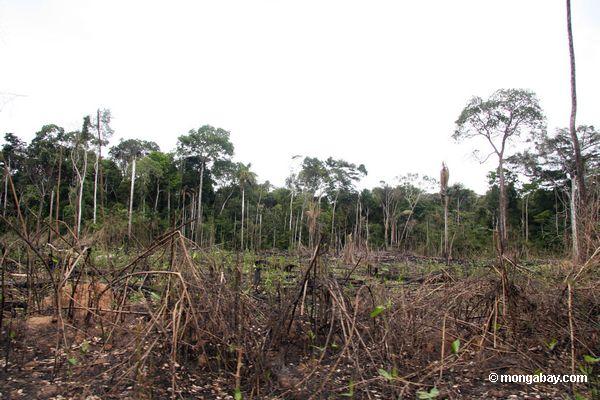 L'Agriculture sur Brûlis dans la forêt tropicale près de Puerto Maldanado, Pérou. (Photo de R. Butler)
|
|
THREATS FROM HUMANKIND
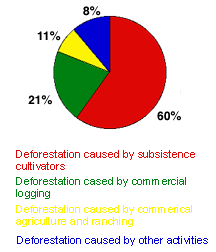
De nos jours, la plus grande cause de la destruction de la forêt tropicale vient d'activités humaines, qui, contrairement les dégât naturels, sont constants et très entiers. Bien que la majorité de cette déforestation est poussée par les forces économiques nationales et internationales, la majorité n'a pas de but à long terme; et résulte d'activités de subsistance a un niveau local. Nombre des effets de destruction de la forêt tropicale causée par les humains sont probablement irréversibles de notre temps.
Le rôle des humains dans la déforestation des forêts du monde est considérable et étendu. De nombreuses activités contribuent à cette perte incluant les activités de subsistance, l'extraction de pétrole, l'abattage des arbres, les exploitations minières, les feux, la guerre, l'agriculture commerciale, l'élevage du bétail, les projets hydroélectriques, la pollution, la chasse et le braconnage, le ramassage de bois à brûler et de bois de construction, et la construction de routes. Avec les pratiques actuelles, les industries d'extraction (bois, pétole, et minéraux) promeuvent le développement de boums à courts termes qui encouragent l'implantation permanente. Ces boums et les colonies en résultant peuvent attirer de grands nombres de pauvres à la recherche d'une vie meilleure. Ils nettoient la terre environnante pour les besoins de l'agriculture et du bétail. Pendant ce temps, la ressourse de la forêt, que ce soit du pétrole, du bois, ou des minéraux, est rapidement épuisée avec très peu d'égards pour les conséquences à long terme. Une fois que la ressource est épuisée, l'industrie se déplace vers de nouveaux endroits, laissant derrière des colonies dépendantes de l'extraction de la ressource pour leur survie et un environnement dégradé. Le seul recours pour les colons est de pratiquer une agriculture de subsistance en dégageant ce qui reste de forêt. Les plupart des processus d'extraction dans le forêt tropicale ne sont pas viables pratiquées telles qu'elles le sont actuellement.
Comme la plupart des atouts environnementaux, les forêts tropicales sont mises en danger par leur statut de ressource en libre accès ou de propriété commune. (Désigner les forêts tropicale de ressource en libre-accès n'est pas complètement juste, du fait du manque de droits de propriétés formels dans certains pays et les capacités limités qu'ont de nombreux gouvernements à gérer te réguler les terres des forêts tropicales. Cependant, traiter la forêt comme telle sied à ce débat). En libre accès, aucun groupe n'a l'usage exclusif des ressources la forêt tropicale, mais tout le monde peut avoir accès à cette ressource. Il y a peu de motivation à la conservation avec la mentalité du "Si je prends pas la ressource quelqu'un d'autre le fera," est la forêt est épuisée autant par l'industrie que par les petits fermiers. En plus, les encouragements économiques tels que des subventions et des exonérations d'impôts pour les développeurs de la forêt déforment les coûts directs enegendrés par la récolte et la conversions de forêts tropicales humides. Le résultat est un échec dur marché, où les prix des boix tropicaux et autres biens dérivant de la destruction de la forêt tropicale ne reflète pas le coût environnemental entier de la perte des biens et services fournis par l'écosystème. Ainis, en offrant ces encouragements, le gouvernement rend rentable pour les entreprise la conversion de la forêt pour des besoins de développements lorsqu'elle ne le serait normalement pas firms.
Un autre acteur de la destruction commerciale de la forêt est la dette important des pays en voie de développement, qui les pousse à chercher des moyens rapides de trouver des fonds afin de pouvoir payer les échéances de leurs dettes. Cependant, la raison élémentaire sous-jacente de la déforestation est la croissance de la population, à la fois dans les pays en voie de développement, qui dépendent des terres des forêts pour leur subsistance, et dans les pays développés, qui demandent des produits tirés des ressources de la forêt.
Nous humains avons toujours déboisé la forêt pour nos propres intérêts, mais dans le passé, le processus était lent et seules des régions limités étaient déboisées, généralement pour les bseoins d'une agriculture de subsistance. Cependant, aujourd'hui les humains sont beaucoup plus efficaces au déboisement de la forêt avec notre technologie et machinerie avancée et la volonté de faire des profits à court terme.
Questions pour résumer:
- Quelle est la cause principale de la déforestation?
[Imprimer]
Suite: Activités de Subsistance
À moins qu'où expressément indiqué, tout contenu sur ce site Web ait été écrit par Rhett A. Butler. Ce site Web a été traduit par Doriane A.
Otras paginas:
|
|
|
|
MONGABAY.COM
Mongabay offre des actualités et des informations sur la faune et l'environnement.
Mongabay.com cherche à éveiller l'intérêt pour la faune des zones sauvages, tout en examinant l'impact sur la conservation et le développement des nouveautés concernant le climat, l'énergie, les technologies, les sciences économiques et les finances.
Sommaire
Acheter des photos
|
|
|
|